
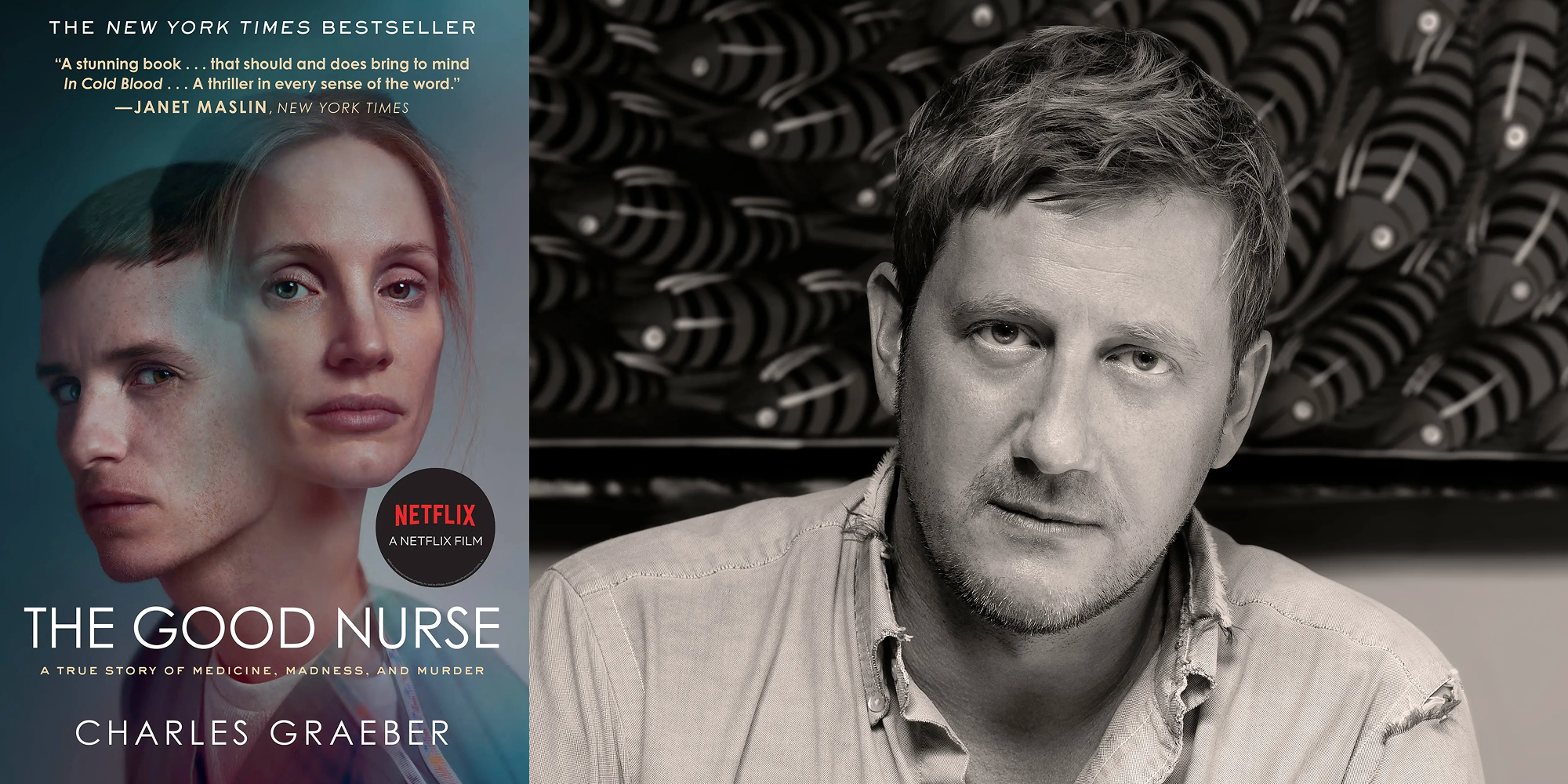
Charles Graeber, author of The Good Nurse
"Being able to be disorganized sometimes, or rushed, and still capture what I need — I'd say this is the greatest asset Alice has brought to my work."
— Charles Graeber, author of The Good Nurse
Charles Graeber is an investigative journalist whose work appears in The New York Times Magazine, Wired, GQ, and Bloomberg. His book The Good Nurse became a major Netflix film starring Jessica Chastain and Eddie Redmayne. He is currently investigating unsolved murders.
Investigative journalism presents a fundamental tension: the need to capture everything versus the need to stay organized. A single book project can require hundreds of interviews. Not every interview will be fruitful, but most contain at least one critical detail somewhere within them.
"I'm essentially an investigator, documenting a crime," Graeber explains. "Statements matter in the sense of proof or clues, especially statements by bad guys or unwilling sources. Documentation is hugely important."
Previous solutions created friction at every step. Paid transcription services meant financial disincentives to transcribe everything, plus time delays that broke the connection between recording and insight. Word's built-in transcription wasn't mobile or fast enough. Apple's recording-to-Notes workflow lacked the seamlessness required for sensitive, on-the-fly interviews.
The result: too many recordings created overwhelming, unlabeled data. Important information got buried. Critical moments were missed because the technology required attention that should have gone to the source.
Alice changed how Graeber approaches his work. The core value isn't just transcription accuracy — it's the elimination of cognitive load in high-stakes situations.
"I'm dealing at present with unsolved murders," he says. "Knowing I can easily capture all of the elements of a conversation gives me a greater sense of ease in conducting these interviews almost anywhere at any time."
The workflow now works with how journalists actually operate. Each recording is automatically timestamped and location-tagged. Transcripts are instantly available for review. Files can be organized by project as they're created, not sorted from a massive backlog later.
"Recording subtly — not in secret necessarily, but in a manner that doesn't spook the subject — is essential," Graeber notes. "Any barriers to that are major impediments."
Alice's transcripts integrate with AI tools to create a compound system. Graeber feeds transcripts into NotebookLM, creating a searchable archive across hundreds of interviews while maintaining source attribution — critical for journalists who must trace every fact back to its origin.
"Working as a journalist means you need to maintain the connection between information and the source of that information," he explains. "I can get a sense of the 'whole' picture while keeping sourcing intact."
The time-coded transcript paired with the original recording allows for precision verification. When Graeber finds a relevant passage through AI search, he can jump directly to that moment in the audio to verify nuance, capture emotion, or clarify details the transcription couldn't fully convey.
"Previously, too many recordings created a problem. Too much transcription solved some of that but created other problems. With AI, the convenience of creating a great many recordings and transcriptions does not lead to the overwhelming inconvenience of too much data for one person to work with. It's a happy pairing."
Graeber now conducts more recorded interviews than ever before. The friction that once caused him to selectively record — gambling on which conversations would prove important — is gone.
"I used to back up my recordings in the most ridiculous belt-and-suspenders manner, including emailing them to myself, and wasn't always sure what all my recordings were. Now Alice does this for me."
More importantly, the quality of his interviews has improved. Without the cognitive overhead of managing technology, he can be fully present with sources — listening actively, following threads, building rapport.
"Note taking can be exhausting, especially when it's simultaneously done with actually speaking and actively listening. It's always tempting to give up and just decide, well it's all on tape anyway, I'll get it later. The problem of course is you don't always get to it later."
With Alice, "getting to it later" happens automatically. The transcript is ready. The recording is preserved. The investigator can focus on what matters: the story.
"My job is best if I can keep everything — record and transcribe everything without concern as to whether it's important, as I don't always know what will prove to be important in time."
Alice is the recording and transcription tool built for professionals who can't compromise on confidentiality. With 98.7% transcription accuracy, end-to-end encryption, and zero data collection, Alice serves journalists protecting sources, lawyers protecting privilege, and researchers protecting subjects.
Learn more at aliceapp.ai
© 2026